Every day, we receive emails from people looking for an accordion teacher, a repair shop, or an accordion club in their area. We try to answer these questions as best we can — usually with information cobbled together from abandoned pages across the web — but it’d be much easier if there was a thorough, up-to-date, searchable list we could point people towards.
So today, we’re launching the Let’s Polka accordion directory, a catalog of accordion teachers, repair shops, and clubs across North America. Just visit the directory, type in your city, hit “Go!”, and you’ll see a list of accordion resources in your immediate area. You can also browse each category — teachers, shops, and clubs — individually.
We’ve gone ahead and added a bunch of listings already, but we know there are a lot more out there. That’s where you come in! If you want to add (or edit) a listing in our directory, just contact us and we’ll take care of the rest. (Listings are entirely free.) We know there are a lot of clubs and teachers that don’t have websites that we’ve probably missed, so hopefully we can work together to get them publicized online.
We have a lot of ideas for improving and expanding the directory, but we hope this is a useful first step towards making this information more readily available. If you have any questions or suggestions, drop us a line or leave a comment on this post. Happy searching!
The school opened in June and has teachers giving lessons in chromatic, piano, and GCF diatonic button accordion. Sheila and Mark are promoting a “studio environment” with private, group, and band lessons, emphasizing styles like Tex-Mex, Norteño, Conjunto, Zydeco, and more. In addition to Sheila and Mark, the studio’s staff includes Mario Pedone and Ross Witte.
Houston Accordion Performers will hold an all-day celebration on September 12th to celebrate its grand opening. The day will start with the studio’s accordion band appearing in Houston’s Fiestas Patrias International Parade, followed by a concert back at the studio. Check our calendar for details and directions.
We’ve been seeing a lot of encouraging signs that the accordion is gaining popularity — one of which is a sharp increase in emails from people who want to learn how to play the accordion. Even better, we keep finding new resources to help them get started. Here are a few we’ve uncovered recently…
Accordion lesson books have always been a popular topic on our site and recently I’ve had a couple accordion teachers recommend a relatively new series from Santorella Publications. Written by Jay Latulippe, Santorella’s three book series isn’t as deep as the venerable Palmer-Hughes series (which has ten), but it includes more contemporary styles and each book comes with a companion CD. Santorella also publishes two diatonic button accordion lesson books (also with CDs) by Henry Doktorski.
Books are great, but working directly with an accordion teacher is even better. For those who can’t find a local teacher, Duane Schnur’s online accordion lessons may be the next best thing. Recently retired, Duane taught accordion for nearly forty years and has decided to “give something back” in the form of these free downloadable lessons. There are forty-six lessons available so far; each includes a PDF with sheet music and an MP3 of Duane leading the lesson.
For visual learners, the rise of YouTube has made it incredibly easy to find and share lesson videos online. For instance, I’ve always struggled with the bellows shake, but thanks to this video from Australian accordionist Dave Evans, I’m well on my way to becoming the next Dick Contino.
Finally, readers may have noticed the link to Debra Peters’ The ABC’s of Accordion Basics lesson DVDs on our site. We’ll do a full review of her DVDs in a future post, but if you’re looking for an introduction to rock and blues accordion, there’s no better place to start.
Have you come across a particularly good accordion lesson book, video, or other learning aid recently? Leave a comment and let us know.
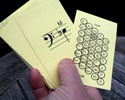
Like many accordion players, Bill Funkhouser came to the accordion from the piano and figured, “It has a piano keyboard… how hard could it be?” And then, like many accordion players, he struggled to master the layout of buttons on the bass side of his accordion.
So to help others making the same transition from piano to accordion, Bill came up with a novel study aid: Accordion Flashcards. Much like those old cards you used to cram for finals, these cards quiz you on the layout of basses and chords in the Stradella bass button system. The cards currently come in two varieties: a 12 bass set ($7.95) and a standard set ($12.95). Check out this sample card and start studying:
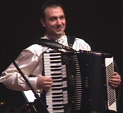
Bulgaria seems to have no shortage of great accordionists and Milen Slavov is one of the brightest lights in Balkan traditional and contemporary music. He moved to America in 1997 and currently performs, composes, produces, and teaches throughout the United States and Canada. I know a few of our readers saw him perform with the Yuri Yunakov Ensemble at the International Accordion Festival in San Antonio last year.
We’ve seen some online accordion lesson courses before, but nothing quite like the ones that Milen is currently offering through his website. He offers both custom audio (he’ll send you an MP3) and custom video lessons based around one of four subjects: ornaments in Bulgarian music, Bulgarian/Balkan piano accordion music, phrases and techniques, or improvisation. Even cooler, though, you can schedule face-to-face lessons to be conducted via webcam.
Normally, I’m a little skeptical of online video lessons because there’s no substitute for the feedback you get from a real teacher. But I’ll admit I’m intrigued by the possibility of taking lessons (even long-distance ones) from one of the world’s top accordionists. If anyone out there takes a lesson from Milen, let us know. I’d be really curious to hear how it goes.
Registration for Lark Camp has begun! This is the 28th year of the world music and dance camp that takes place in the Mendocino Woodlands in Northern California, August 1-9 2008. You can register for full camp (all 8 days) or half camp (4 days) either online or by mail.
Along with an extensive list of dance and vocal instructors, there is an instructor in practically every acoustic instrument and world music style that you can imagine. Accordion instructors include Javier Blanco (Galician Accordion), Claudette Boudreaux (Cajun & Creole Button Accordion, Cajun French Songs), Alan Keith (Button Accordion), Louis Leger (French Canadian Songs, Quebecois Button Accordion), Keith Livingstone (Piano Accordion), and Vickie Yancy (French Music & Button Accordion). There are also a variety of jam circles (Cajun/Zydeco, English country dance music, Old time music) to join in!
Check their website for more information about prices, registration and to hear some great sound bytes of the instructors’ music.
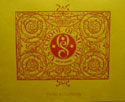
Can’t find an accordion teacher in your area? Don’t have time for formal lessons? The U.S. School of Music had a solution: an accordion home study course available via mail order. This particular set — copyright 1930, but mailed in 1942 — contains four lesson books (“Home Study Lessons for Piano and Chromatic Accordion”), as well as twelve records to accompany the lessons. I’m tempted to bid just so I can get a closer look at the study materials. Plus, I’ve always wanted to take a correspondence course… in accordion.
Expert Village bills itself as the “world’s largest how-to video site,” but even I was surprised to find their series on learning to play the accordion. The 15-part series (each part is about 3 minutes) is led by Brett Larsen, a middle-school teacher who plays in the Santa Barbara band, Spencer the Gardener. The series is very basic — “Mary Had a Little Lamb” is one of the tunes taught — but you can’t beat the price (free). Here’s a clip:
If you’re interested in more advanced video lessons for the diatonic accordion, check out our previous post on the Italian Accordion Academy online.
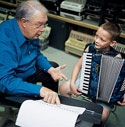
Last month, the Washington Post Magazine had a glowing feature on Virginia accordion teacher Dale Wise. Three years ago, Wise started Accordions for Kids, a program designed to introduce a younger generation to the accordion.
Accordions for Kids is essentially a no-risk trial program for eight to twelve-year-old accordion students. Each student is loaned a 12-bass accordion and study materials (music stand, sheet music, etc.) and receives 10 weeks of lessons with a teacher free of charge. At the end of the program, the student performs in a recital and then decides (along with with his/her parents, of course) whether to continue. Children usually love it — and are oblivious to any stigma associated with accordion playing — but parents often need convincing:
“There’s some selling that has to be done… But this accordion thing is going to happen, one way or the other. How big it becomes is just a matter of how much energy we got.”
Accordions for Kids has been so successful that Wise has recruited teachers nationwide to participate. I absolutely love the idea and hope it continues to spread. Maybe one day we’ll have a nation of “accordion moms,” loading minivans full of accordions and shuttling them to lessons and recitals…
I have a question for the button accordionists out there: I am learning to play button accordion (after having played piano accordion for 15 years) and have been having a really hard time playing (remembering!) the correct button fingerings when I change the direction of air flow to my bellows. When beginners (like me) are learning a song, how do you recommend we go about it? Is it better to learn via rote memorization, breaking the song down into two-measure chunks — playing two measures with the bellows pulling out, then two measures pushing in? Or is there another method you prefer? Thanks in advance!

 Last month, the Washington Post Magazine had a glowing feature on